
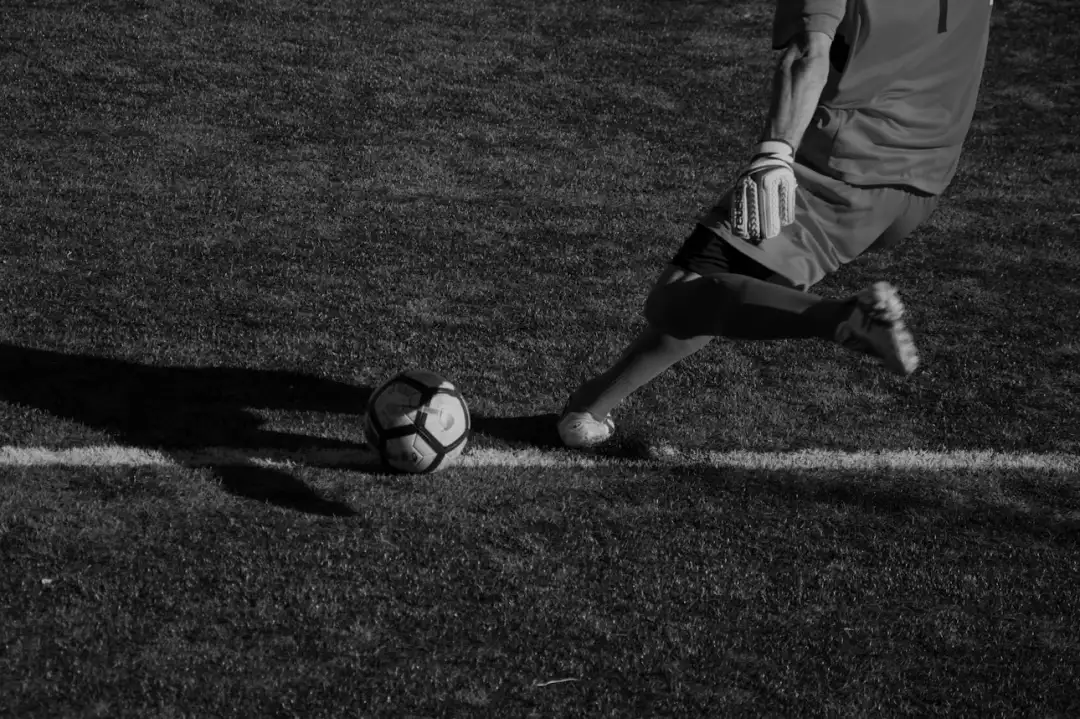
Gym workout for footballers: pre-season, in-season and off-season
Gym work for football (soccer) should cover single-leg strength, hamstrings, adductors, calves and ankles, and the trunk. Do two or three sessions a week in pre-season, one or two lighter ones in-season kept away from match day, and use the off-season to rebuild. Below: a sample session, a week around a Saturday match, and what the research found.
This page sticks to what the research and common practice support, and says where the evidence is thin.
What a footballer’s gym work should cover
- Single-leg strength. Sprinting, cutting and landing all happen on one leg: split squats, step-ups, single-leg Romanian deadlifts.
- Hamstrings: the Nordic hamstring curl. A 2020 review of the research graded the evidence as moderate to high quality that programmes including Nordic curls had fewer hamstring injuries than usual training (Ishøi et al., BJSM 2020).
- Adductors: the Copenhagen adduction. In a 2017 trial with under-19 players, replacing the Nordic in the FIFA 11+ warm-up with the Copenhagen adduction increased hip adduction strength, while the standard FIFA 11+ didn’t (Harøy et al., 2017). A 2019 trial of 652 semi-professional players found 41% lower odds of reporting groin problems in teams that did a Copenhagen-based programme (Harøy et al., BJSM 2019). The 2020 review graded the groin evidence for FIFA 11+ and the Copenhagen programme as low to moderate.
- Calves and ankles. Straight-knee and bent-knee calf raises, and some hopping, for sprints and changes of direction.
- Trunk. Side planks and anti-rotation work, so you hold position when you’re turning or being pushed.
- Acceleration support. Hip extension (hip thrusts, sled pushes if your gym has one) and low, quick hops. Your sprinting is done on the pitch; the gym supports it.
How strong is the evidence overall? Weaker than single studies suggest. A 2023 review of 15 trials, searching the research up to June 2022, called the effect of multi-component injury prevention programmes in football “uncertain and inconclusive”, with most results based on low-quality evidence (Obërtinca et al., Sports Medicine). So use the exercises above as sensible gym work that the best football studies keep coming back to. None of them comes with a guarantee. If you have pain or an injury, see a physio, and if your team has a coach or physio, their plan comes first.
A sample gym session for footballers
About 50 minutes. Use it as a full session in pre-season and the off-season; in-season, cut the sets and keep the Nordics and Copenhagens.
| Block | Exercise | Sets × reps | Why |
|---|---|---|---|
| Warm-up | Skips, leg swings, lateral lunges, a few build-up runs | 8 min | Raises temperature; moves hips in every direction |
| Single-leg strength | Rear-foot elevated split squat | 3 × 6–8 each leg | Running, cutting and landing happen on one leg |
| Hamstrings | Nordic hamstring curl | 2–3 × 4–6 | Lengthening strength for sprinting |
| Hamstrings | Single-leg Romanian deadlift | 3 × 8 each leg | Hip-hinge strength and balance |
| Adductors | Copenhagen adduction (short lever to start) | 2–3 × 5–8 each side | Groin strength for passing, shooting and cutting |
| Calves and ankles | Straight-knee and bent-knee calf raise | 3 × 12–15 | Ankles and Achilles for sprints and changes of direction |
| Trunk | Side plank, band press-out | 2–3 × 30 s / 10 each side | Holding position when you're pushed or turning |
| Acceleration support | Hip thrust, then low pogo hops | 3 × 8, then 2 × 15 s | Hip extension and springy ankles behind the first steps |
New to Nordics or Copenhagens? Start with fewer reps and a shorter range (or the short-lever Copenhagen with the knee on the bench), and add a little each week. Both leave you sore at first, so don’t start them in a match week. Your AI can add any exercise the Nextset library doesn’t have, such as the Nordic curl or the Copenhagen adduction.
Football pre-season gym workout
In the weeks before the season, two to three gym sessions a week. This is when you build strength you’ll try to keep for the rest of the year. In the 2019 adductor trial, teams did the Copenhagen programme three times a week through a 6–8 week pre-season (Harøy et al.). Team training and fitness work ramp up at the same time, so start the gym sessions lighter than you think and build.
Footballers in-season
In-season, keep gym work to one or two short sessions a week, light before games: see in-season strength training for how often and how heavy, and game day training for the days around a match.
Off-season soccer training program
After a short break, rebuild: two to three sessions a week, more sets than you’d manage in-season, and time to bring back anything that slipped over the season, such as hamstring or groin strength. It’s also the easiest time to learn the Nordic and Copenhagen properly, with no matches to work around.
A weekly gym plan around a Saturday match
An in-season week with team training on Tuesday and Thursday and a match on Saturday. Move it as one piece if your match is on Sunday.
| Day | Plan |
|---|---|
| Sunday | Recovery: a walk, mobility, easy bike |
| Monday | Gym: the main session of the week (single-leg, Nordics, Copenhagens, calves) |
| Tuesday | Team training |
| Wednesday | Gym, optional and short: upper body and trunk, low-volume legs, or rest |
| Thursday | Team training |
| Friday | No heavy legs: rest, or 15 minutes of mobility and activation |
| Saturday | Match |
Five-a-side and Sunday league players
The same pieces apply if you play five-a-side on a weeknight or Sunday league at the weekend. You probably have fewer games and no team physio, and the gym sessions are yours to plan. Two sessions a week is plenty for most. The one habit worth keeping: no heavy leg work the day before you play. If you play twice a week, put your leg session two days after one game and at least two days before the next.
Your week rarely stays the same, which is where an AI assistant helps. Nextset is a workout tracker your AI can edit: you tell Claude, ChatGPT, Grok or Gemini about the game, and it rewrites the session in the app. The app plays each session with timers and logs every set; it doesn’t change the plan on its own. A ready-made soccer program is coming soon, but isn’t available yet. Until then, your AI can write the sessions above into Nextset for you. For racket sports, see the tennis page; for everything else, the athlete hub.
Worked example: five-a-side tomorrow
The rule. Saved once as an athlete rule, so it applies on every program: “No heavy leg work the day before a match.” Your AI reads it and honours it before it writes anything; the app itself doesn’t enforce it.
The event and the prompt. Wednesday is a leg day. Five-a-side comes up for Thursday night, so you send one line:
Five-a-side tomorrow at 7pm. Add it to my calendar and sort out today's session.
What happens. The AI adds the match to your calendar, reads your rule, and rewrites today’s session: today becomes upper body and trunk, and the heavy leg work waits for Monday’s leg day, well clear of the match. It writes today only; ask again on Sunday if Monday needs changing.
In Nextset afterwards:
- Thursday shows the five-a-side match on your week.
- Today: warm-up, upper body (push-up, band row, pullover), trunk (side plank, band press-out) and mobility, about 40 minutes.
- No leg work before the match. Legs move to Monday, with the split squats, Nordics and Copenhagens.
More lines like this in the prompt library, and how the app and your AI split the work in AI workout trackers compared.
FAQ
How many times a week should a footballer go to the gym?
Two to three sessions a week in pre-season and the off-season, and one or two in-season. In a small 2011 trial with professional players, one strength session a week through the first 12 weeks of the season kept the strength gained in pre-season; one every second week didn't.
Should footballers do legs the day before a match?
A common habit is to keep heavy leg work away from the day before a match: rest, mobility or a short activation session. Put the main leg session early in the week, two or more days before the game.
What is a good pre-season gym workout for football?
Two to three full sessions a week built on single-leg strength, Nordic hamstring curls, Copenhagen adductions, calf raises, trunk work and some hip and ankle work for acceleration. Start light in the first weeks, because team training ramps up at the same time.
What should footballers do in the off-season?
Take a short break, then rebuild: two to three sessions a week with more volume than you'd manage in-season, and time to bring back anything that slipped, such as hamstring or groin strength.
Do Nordic hamstring curls stop hamstring injuries?
No exercise can promise that. A 2020 review graded the evidence as moderate to high quality that programmes including Nordic hamstring curls had fewer hamstring injuries than usual training. If you have a hamstring injury or pain, see a physio before you start them.
Is this only for club players, or for five-a-side and Sunday league too?
Both. The same pieces apply; you'll just fit fewer sessions around fewer games. Tell your AI which nights you play and it can keep heavy leg work away from them.
Does Nextset have a soccer program?
Not yet. A ready-made soccer program is coming soon. Today your AI assistant can write your football gym sessions into Nextset, and the app plays them with timers and logs every set.
Sources
All checked on November 25, 2026.
- Ishøi L, et al. Diagnosis, prevention and treatment of common lower extremity muscle injuries in sport: grading the evidence. Br J Sports Med, 2020
- Harøy J, et al. Including the Copenhagen adduction exercise in the FIFA 11+: a randomized controlled trial. Am J Sports Med, 2017
- Harøy J, et al. The Adductor Strengthening Programme and groin problems in male football players: a cluster-randomised controlled trial. Br J Sports Med, 2019
- Obërtinca R, et al. Efficacy of multi-component exercise-based injury prevention programs among footballers: a systematic review and meta-analysis. Sports Med, 2023
- Rønnestad BR, et al. Effects of in-season strength maintenance training frequency in professional soccer players. J Strength Cond Res, 2011
Nextset is for general strength and mobility, not medical advice. If you have pain, an injury or a condition, see a professional.
Gym work that fits around your season.
Nextset is in invite-only beta. Join and we’ll send your invite.
Join the beta